
Where Is The Microphone On The iPad?
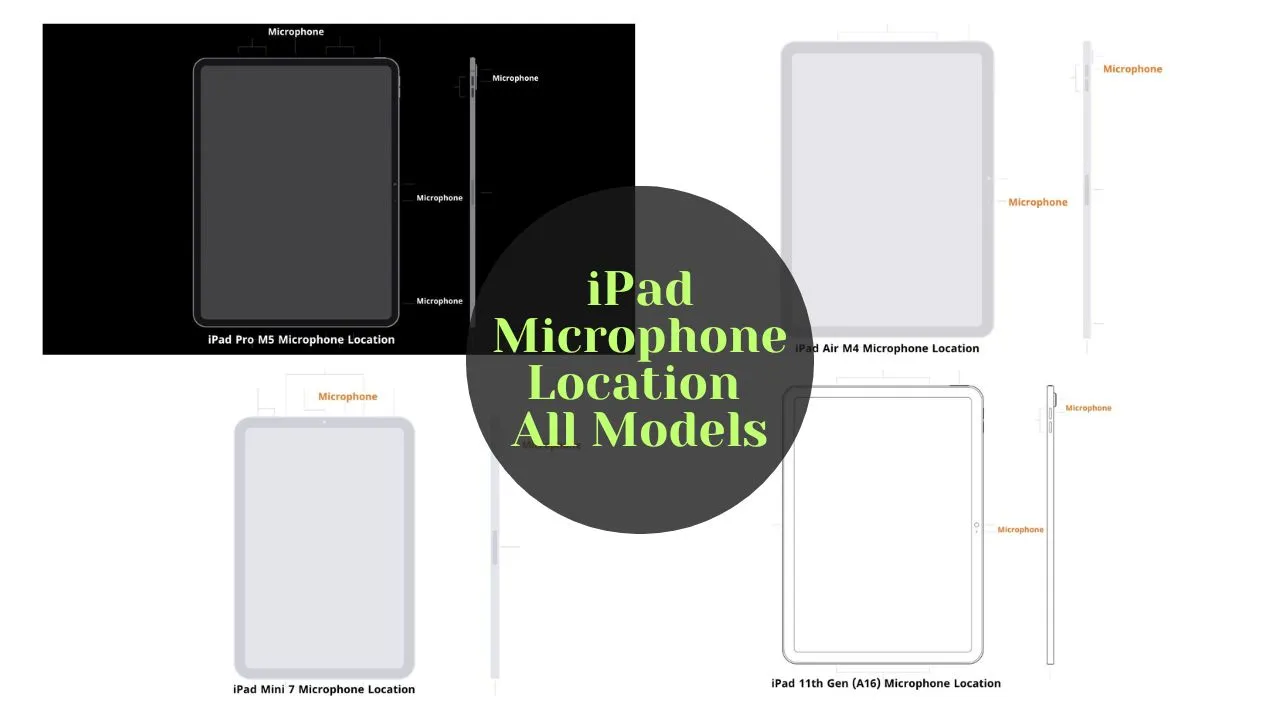
Knowing where the microphone is on your iPad can make a real difference; it helps you avoid accidentally blocking it during calls, position the device correctly for recordings, and get the most out of voice features like AI assistant and dictation. The specific placement of the microphone, however, can vary across iPad models and generations. In this article, I’ll cover the microphone locations on different iPads. Whether you have an older iPad Air or a newer iPad Pro, you’ll learn exactly where the microphones are placed.
Why Knowing the Location Matters
Understanding where the microphone is located on your specific iPad is essential. It impacts how you interact with your device, the audio quality of your recordings, and the effectiveness of voice commands. Knowing the location can also help you avoid accidentally covering or obstructing the microphone during use. Paying attention to the built-in microphone placement goes a long way towards user experience and creating great audio content with the iPad.
Locating the Microphone on Different iPad Models
iPad models over the years have had front- or rear-facing mics in various positions. Here are some of the most common microphone placements:
Microphone Location on iPad Basic

The iPad has evolved over 11 generations since its debut in 2010, making it the longest-running and most accessible model in Apple’s tablet lineup.
The 1st through 4th-generation iPads (2010–2012) featured a single microphone on the top edge of the device. With the 5th and 6th generations (2017–2018), Apple moved the single microphone to the back of the device to improve audio capture.
Starting with the 7th generation (2019), Apple introduced a second microphone, placing one on the top edge and one near the rear camera, a configuration that continued through the 8th and 9th generations (2020–2021). With the redesigned 10th generation (2022) and the 11th generation (2025), the microphone placement shifted to reflect the new landscape front camera layout: one microphone sits near the landscape front camera on the front bezel, and the other remains near the rear camera.
| iPad Generation | Number of Microphones | Microphone Location |
|---|---|---|
| iPad 1st gen (2010) | 1 | Top |
| iPad 2nd gen (2011) | 1 | Top |
| iPad 3rd gen (2012) | 1 | Top |
| iPad 4th gen (2012) | 1 | Top |
| iPad 5th gen (2017) | 1 | Back |
| iPad 6th gen (2018) | 1 | Back |
| iPad 7th gen (2019) | 2 | Top and Rear camera |
| iPad 8th gen (2020) | 2 | Top and Rear camera |
| iPad 9th gen (2021) | 2 | Top and Rear camera |
| iPad 10th gen (2022) | 2 | Front (near landscape front camera) and near rear camera |
| iPad 11th gen (2025) | 2 | Front (near landscape front camera) and near rear camera |
Microphone Location on iPad Mini

The iPad mini has evolved through seven generations since its initial release in 2012. The first iPad mini featured a single microphone located at the bottom of the device. Starting with the 2nd generation, Apple integrated a dual-microphone setup, one on the top edge and one near the rear camera, a configuration that has remained consistent across the 2nd through 7th generations (2013–2024).
The dual-microphone design enables improved noise cancellation and voice capture during video calls, audio recordings, and dictation. While the iPad mini has seen changes in external design, processing power, and display quality over the years, its microphone count and placement have stayed unchanged since the 2nd generation.
| iPad Generation | Number of Microphones | Microphone Location |
|---|---|---|
| 1st | 1 | Bottom |
| 2nd,3rd,4th,5th,6th, 7th | 2 | Top and rear (with rear camera) |
Microphone Location on iPad Air

The iPad Air, regardless of generation, features a dual-microphone setup for audio input. These two microphones are strategically placed on the device: one positioned at the top (or front bezel on M-chip models) and another on the rear of the device near the back camera to optimize sound capture and enhance the overall audio experience during various activities such as video recording, FaceTime calls, and voice interactions.
| iPad Generation | Number of Microphones | Microphone Location |
|---|---|---|
| iPad Air (1st gen, 2013) | 2 | 1 on top, 1 on rear (back) |
| iPad Air 2 (2014) | 2 | 1 on top, 1 on rear (back) |
| iPad Air (3rd gen, 2019) | 2 | 1 on top, 1 on rear (back) |
| iPad Air (4th gen, 2020) | 2 | 1 on top, 1 on rear (back) |
| iPad Air (5th gen, 2022) | 2 | 1 on top, 1 on rear (back) |
| iPad Air M2 (6th gen, 2024) | 2 | 1 on front bezel, 1 on rear (back) |
| iPad Air M3 (7th gen, 2025) | 2 | 1 on front bezel, 1 on rear (back) |
Microphone Location on iPad Pro

The number and placement of microphones varies across iPad Pro models, generations, and display sizes. Apple’s iPad Pro lineup has spanned four screen sizes: 9.7-inch, 10.5-inch, 11-inch, and 12.9-inch (later renamed 13-inch), each with distinct microphone configurations that evolved over time.
Early Models (2015–2017)
The iPad Pro 9.7″ (2016), 10.5″ (2017), and the 12.9″ 1st and 2nd generations (2015, 2017) all feature a simple dual-microphone setup. One microphone is positioned on the top edge, and the other is located near the rear camera. This 2-mic configuration was sufficient for Apple’s early Pro lineup but was later upgraded as the hardware matured.
Mid-Generation Upgrade (2018–2022)
Starting with the iPad Pro 11″ 1st generation (2018) and the 12.9″ 3rd generation (2018), Apple significantly upgraded the audio system to include five studio-quality microphones. Three microphones are placed along the top edge, one near the rear camera and one on the left side — a configuration that continued across all 11″ and 12.9″ models through the 4th-generation 11″ and 6th-generation 12.9″ (both 2022). This expanded array greatly improved spatial audio capture, noise cancellation, and recording quality for professional use cases.
Latest Generations (2024–2025)
With the introduction of the ultra-thin M4 iPad Pro in 2024 and the M5 in 2025 available in both 11-inch and 13-inch sizes, Apple redesigned the microphone layout to a four-microphone studio-quality array. The four microphones are distributed across the top edge, front bezel, right side, and rear of the device, optimized for the dramatically thinner chassis while maintaining high-quality audio capture for calls, video recording, and creative audio work.
| iPad Pro Model | Number of Microphones | Microphone Location |
|---|---|---|
| iPad Pro 9.7″ (1st gen, 2016) | 2 | 1 on top, 1 on camera |
| iPad Pro 10.5″ (2nd gen, 2017) | 2 | 1 on top, 1 on camera |
| iPad Pro 12.9″ (1st gen, 2015) | 2 | 1 on top, 1 on camera |
| iPad Pro 12.9″ (2nd gen, 2017) | 2 | 1 on top, 1 on camera |
| iPad Pro 11″ (1st gen, 2018) | 5 | 3 on top, 1 on camera, 1 on left |
| iPad Pro 12.9″ (3rd gen, 2018) | 5 | 3 on top, 1 on camera, 1 on left |
| iPad Pro 11″ (2nd gen, 2020) | 5 | 3 on top, 1 on camera, 1 on left |
| iPad Pro 12.9″ (4th gen, 2020) | 5 | 3 on top, 1 on camera, 1 on left |
| iPad Pro 11″ (3rd gen, 2021) | 5 | 3 on top, 1 on camera, 1 on left |
| iPad Pro 12.9″ (5th gen, 2021) | 5 | 3 on top, 1 on camera, 1 on left |
| iPad Pro 11″ (4th gen, 2022) | 5 | 3 on top, 1 on camera, 1 on left |
| iPad Pro 12.9″ (6th gen, 2022) | 5 | 3 on top, 1 on camera, 1 on left |
| iPad Pro 11″ M4 (7th gen, 2024) | 4 | 1 on top, 1 on front bezel, 1 on right, 1 on rear (back) |
| iPad Pro 13″ M4 (7th gen, 2024) | 4 | 1 on top, 1 on front bezel, 1 on right, 1 on rear (back) |
| iPad Pro 11″ M5 (8th gen, 2025) | 4 | 1 on top, 1 on front bezel, 1 on right, 1 on rear (back) |
| iPad Pro 13″ M5 (8th gen, 2025) | 4 | 1 on top, 1 on front bezel, 1 on right, 1 on rear (back) |
Conclusion
The iPad’s built-in microphone placement has evolved over the years across models, advancing audio capabilities. Understanding the exact locations, whether it’s a single mic up top or multiple mics strategically positioned, enables optimal use. Proper microphone positioning captures better sound, isolating vocals and reducing noise. By fully utilizing the integrated microphone in your iPad, you can enjoy a more immersive and personal audio experience.
Frequently Asked Questions
It depends on the generation. iPad Pro models from 2018 through 2022 (11-inch and 12.9-inch) feature five studio-quality microphones. The newer M4 and M5 iPad Pro (2024–2025) use a redesigned four-microphone array across the top, front bezel, the right side, and the rear.
No. Every iPad Air generation features a dual-microphone setup: one on the top (or front bezel on M-chip models) and one near the rear camera. iPad Pro models have four to five microphones depending on the generation, giving them superior noise cancellation and spatial audio capture.
Go to Settings → Privacy & Security → Microphone and toggle on the app you want to allow. If the app isn’t listed, it hasn’t requested access yet; try launching the app first to trigger the permission prompt.
The most likely cause is physical obstruction. Your finger, a case, or debris covering the mic opening. Locate the microphone position for your specific model and make sure nothing is blocking it. Also check Settings → Privacy & Security → Microphone to confirm the app has permission. If the issue persists, restart your iPad to clear software bugs.
Starting with the 10th-generation iPad (2022), Apple placed one microphone on the front bezel near the landscape-oriented front camera. Earlier generations (1st through 9th) positioned microphones on the top edge or rear, not the front face.